ECOS 2026: Prof. Valero, you have promoted over the years strong emphasis on the efficient use of resources with an unified approach to energy and materials. Which are the main advantages of such an approach?
Antonio Valero: We extract minerals, water and energy from the ecosphere, poetically known as Nature. Although the exergy of minerals is very low compared to fossil resources, electricity or nuclear energy, as well as countless chemical compounds, we need to extract them from the planet’s material endowment using physical and chemical processes that utilize exergy to do so. It is not the exergy contained in all these materials that matters to us, but rather the exergy consumed to obtain the raw materials that the Technosphere needs for its development.
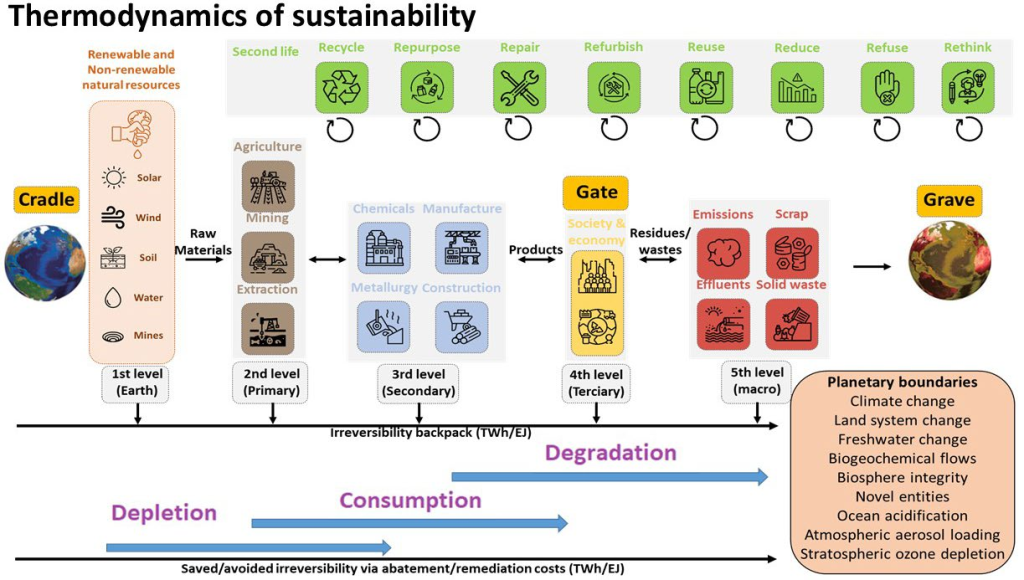
The process of evaluating exergy consumption follows a mathematical input-output structure, which investigates from the root of the resources to the formation of objects with their resulting waste. This structure obeys the laws of thermodynamics. We call this theory the Exergy Cost Theory, because it is isomorphic to the process of forming the Economic Cost, but it is, in short, a natural extension of Thermodynamics applied to the assessment of the destruction of natural resources by human beings. For this reason, we call it the Thermodynamics of Sustainability.
The Thermodynamics of Sustainability extends its scope of study beyond the exergy analysis of conventional processes to include the following concepts:
a) The depletion of natural resources because of their extraction.
b) The impact on planetary boundaries of the waste produced in the production process from extraction to the end of the product’s life.
c) Co-production must distribute inputs among outputs using only physical rules.
d) Of course, it includes the exergy analysis of conventional processes. TS must be a theory that evaluates the overall impact on nature of each and every object used by the Technosphere. Every natural or anthropogenic process destroys exergy, and what was will never be again. Irreversibility is everywhere but no longer remains in the realm of philosophy; it can be quantified in energy units, thanks to the Gouy-Stodola theorem, in which the exergy destroyed is also called Irreversibility and is the product, T0 , of the entropy generated, Sg .
Obviously, there are regeneration operations that reduce irreversibility, and by taking advantage of renewable energies, it can be reduced. Therefore, exergy accounting must include the regeneration processes of any activity associated with the exergy backpack of a specific product. It is interesting to highlight some semantic aspects of such a topic.
i) The term ‘Exergy Cost’ was proposed internationally (1986) independently of Szargut’s Cumulative Exergy Consumption (1987). Later, outside the academic sphere, the term Embodied Exergy was proposed. All three names evoke the same concept.
However, the word ‘cost’ brings to mind and draws on the mathematical developments of Leontief’s Input-Output Theory. Behind the word ‘cost’ lies the thermoeconomics proposed by Tribus in 1971, and the Exergy Cost Theory was awarded the first ASME Edward F. Obert Prize in 1987.
ii) The word ‘irreversibility’ was used independently by Gouy and Stodola in the early 20th century, as the product T0 Sg , no less than 50 years before the word “exergy” was proposed by Rant in 1954. So ‘destroyed exergy’ as a measure of irreversibility came later, although it is more widely adopted as a thermodynamic criterion. To this we must refer to the resurrection of the word irreversibility within economic activities proposed by N. Georgescu-Roegen in 1971.
iii) The words “deterioration”, “degradation” and “dissipation”are used almost interchangeably to describe the entropic generation of a process. However, “deterioration” is the wear and tear of physical equipment over time or through use. “Degradation” is often used to refer to the gradual process of wear and tear of a complex physical system, as well as degeneration. Meanwhile, “dissipation” is used to refer to the fading or dispersion of an energy flow. All three terms are and will continue to be used in thermodynamic jargon, but what remains unchanged is that all three terms describe irreversible processes.
iv) There are more irreversible processes than those aforementioned. These are “depletion”, extinction” and “waste footprint”- all related to the current planetary boundaries. These processes affect the future of the planet and future generations. The ‘depletion’ of a mineral deposit increases the scarcity of the resource and the cost of extracting the next unit grows exponentially. ‘Extinction’ is associated with living systems, both of a species and of an ecosystem. The scarcer they are, the greater the cost of reversing them. The International Union for Conservation of Nature (IUCN) considers nine categories of danger and extinction.
v) Finally, there is the footprint produced by the impact of a set of effects caused by an accidental, voluntary or inadvertent event. Thus, we speak of environmental impact or the impact of waste on currently recognized (and possibly novel) planetary boundaries. These are processes whose evolution over time generates certain irreversibilities, but whose effect is difficult to predict in terms of when, how much and where. For example, the effects of climate change. Current economic practice ignores these undefined damages and classifies them as externalities.
In summary, to answer your question: The objective of the Thermodynamics of Sustainability focuses its analysis on the effect of the Technosphere on the Ecosphere. If human beings want to survive on this planet for a long time, they must manage all their resources and the impact of the waste from their activities. We are not seeking to optimise energy or physicochemical processes, but rather to design a physical theory that evaluates, in terms of irreversibility, the impact of human beings on the planet. We do not have all the answers, and as such, many researchers need to focus their attention and intelligence on developing it.
Complementarily, another ambitious objective we want to reach is for the thermodynamics of sustainability fundamentals to be implemented in all universities around the world.
ECOS 2026: The circular economy and circularity in general are getting more into real applications. Besides the effective benefits for the environment, to your opinion, how could socio-economical circular systems avoid the danger of self-sufficiency and secure a vivid evolution?
Antonio Valero: We do not get involved in socio-economic issues such as market organisation; we just do the maths. Obviously, recycling is not free, either physically or economically. And it is cheaper to recycle an object than the raw materials it is made of. It is necessary to recycle as much as possible, but our current society loves to buy new products rather than value either those we already have or recycled ones. We need to create the most powerful economic sector possible dedicated to recycling in all its facets. In this way, eco-design that favours disassembly considerably reduces its exergy and economic costs. For example, aeroplanes rivet their wings instead of welding them to the central body, and the working hours of an aeroplane are counted in thousands. It is a fact that they are safer than cars. However, a land vehicle lasts no more than ten years on average, and legislation even persuades citizens to buy a new one, even though we know that around 90% of a car’s life is spent parked. A conventional car factory can assemble hundreds of thousands of vehicles a year but does not “know” how to disassemble, renovate and upgrade even one a year. In other words: Yes, change is possible! The technology exists, but there is no public or political will to promote recycling.
In our book Thanatia (2014), we already said that old things are discarded, but antiques are valued. We also said that in English there are more than 4,000 verbs that begin with the Latin prefix “re”.
Valero, Ant., & Valero. Al., ‘Thanatia, The Destiny of the Earth’s Mineral resources: A cradle –to-cradle assessment’. (2014);World Sci. Publ. Co. ISBN 978-981-4273-93-0
Complementarily, global demand for raw materials is intolerable for the planet. There might be many generations like ours if we want our descendants to live as we do. It is a mere thermodynamic calculation. In certain aspects, Earth might be interpreted as a warehouse of resources -but a very disorderly one. Mineral deposits constitute between 0.01 and 0.01% of ecosphere´s mass. The most desirable elements are not necessarily the most abundant. That is why we are constantly creating shortages, all the more so because they are naturally in high demand and scarce. The dynamics of scarcity behave in an entropic, i.e. logarithmic, manner. As a result, the prices of so-called critical materials have been skyrocketing recently. To the best of our knowledge, this obvious phenomenon has never been evaluated in our exergy analyses. The replacement of some materials instead of more abundant ones, and above all recycling, are truly indispensable in our immediate future.
From a thermodynamic point of view, there are concepts to be developed. A material that is valuable because of its properties and scarcity does not necessarily have significant exergy, even considering its exergy cost of extraction from the mine to the market (cradle to market). This is the case for many transition metals in the periodic table. From an ecospheric (nature) point of view, the criterion to be considered for recycling them is not whether their cradle-to-market exergy cost is greater than their recycling exergy cost. In fact, the criterion for recycling is the exergy of scarcity created, i.e. the cradle-to-market exergy of future extraction. What needs highlighted is an assessment of the scarcity created, not of the exergy of current extraction but of future extraction.
You can see some of the articles we have published on Circular Thermoeconomics:
Valero A, Torres C. ‘Circular Thermoeconomics: A waste cost accounting theory’. In the book: Feidt M, A. Valero, editors. Advances in thermodynamics and circular thermoeconomics. London: ISTE-Wiley; 2023, p. 151–213.
Valero A, Torres C. ‘Application of Circular Thermoeconomics to the Diagnosis of Energy Systems’ In Energies 2023, 16(18), 6751; https://doi.org/10.3390/en16186751
In addition, we are developing several projects on recycling, some of these are:
REDOL: https://www.redolproject.eu/the-project/
REDOL is a European-funded project aimed at improving the circularity of the city of Zaragoza by promoting urban and industrial circular economy strategies and fostering municipal–industrial symbiosis. The project focuses on the valorisation of urban and industrial waste and by-products, enabling their reintegration into new production cycles and thereby reducing the consumption of virgin raw materials and associated environmental impacts.
RESTORE
RESTORE is a national research project that critically examines the real sustainability of renewable energy, the circular economy, and sustainable agriculture. Motivated by the severe ecological degradation facing the planet—such as climate change, resource depletion, and soil degradation—the project seeks to assess whether these widely promoted solutions are truly effective in addressing global environmental challenges. RESTORE adopts a thermodynamic approach, using the second law of thermodynamics and exergy as a common metric to rigorously quantify the hidden environmental impacts associated with low-carbon technologies, recycling processes, and agricultural systems. By revealing the material, energy, and resource costs embedded in these systems, the project aims to support more informed decision-making that integrates environmental, economic, and social dimensions.
RELOAD https://www.futurefastforward.es/
RELOAD is a national research project focused on assessing the criticality (thermodynamic criticality), disassemblebility, and recyclability of electric vehicles. The project aims to identify key sustainability challenges related to the use of critical raw materials, vehicle design complexity, and end-of-life management of electric vehicles. Through an integrated assessment, RESTORE analyses material dependency, dismantling processes and current recycling pathways in order to identify improvement opportunities in eco-design, enhance circularity strategies, and reduce environmental impacts and supply-chain vulnerabilities. The project contributes to the development of a more circular, resource-efficient, and resilient electric mobility system.
These projects have led us to rename the term ‘circular’ with the more precise and quantifiable name ‘Spiral’. Circularity does not definitively exist from a thermodynamic, i.e. scientific, point of view.
The Rules of the Spiral Economy.
Considering these ideas, we wanted to take a closer look at the current reality of technology and offer a series of tips for the public and businesses. Here are 18 of them, which are constantly improved.
1) Understand Entropy, which tells us: Do not mix things up, because that is the best way to delay their degradation. Separating them is very costly.
2) Learn from Nature, imitate it by practising biomimicry.
3) Before recycling, think about what to do with the waste, share, repair, reuse and finally recycle. If possible, reproduce the equipment that produced it.
4) The end of life of a piece of equipment is not the same as the end of life of all its components. Dismantle and reuse what works.
5) Recover and extend the life of equipment. Denounce planned obsolescence. We must claim the right to repair.
6) Do not let waste go to landfill. Despite this, urban mining has great potential for recovering old waste.
7) Confessional effect: The end user is ‘free of sin’ when they deposit their waste in the appropriate container and ignore its subsequent life. Be wary of those companies who say they ‘recycle’ but make a living from you producing more and more waste. They are not interested in you reducing your waste, nor will they tell you what and how much they recover from it.
8) Law of Waste Disposal : We must promote actions that begin with the prefixes ‘un’, ‘de’, “di”, or ‘dis’, which imply performing the opposite action to their root verb, but indicating a positive action of recovery such as:
Uncage, uncoupling, undo, unfasten, unfold, unlinking, unmix, unpair, unravelling, unrivet, unroll, unscrew, untangle, untie; declassify, decompose, decontaminate, degrease, dematerialise, demolish, destructurise, detach, detoxify, develop; dilute; disarm, disarticulate, disassembling, disconnect, disintegrate, dismantling, dismember, disintegrate, dissociate, dissolve, distinguish, disunite, etc., are some such verbs. Also, allocate, break down, crumble, cut up, retract, scrap, waste.
9) Legislation effect: current legislation focuses on the separation, classification and disposal of each type of waste. However, this often proves to be an obstacle when companies propose to recycle them. The biggest obstacle to recycling is administrative permits.
10) What is broken down disperses more and pollutes the air, water and soil. Only natural materials break down, because ecosystems assimilate them. The time taken for natural assimilation should be a criterion for the use of artificial materials. Microplastics are the example.
11) Eco-design to enable end-of-life recycling and regenerate the nature that produced its components. The recovery of equipment components must be strategically designed, taking into account comprehensive separation, because if only the most profitable element is recovered, the waste from the process is more difficult to recover for the other components.
12) Physical disassembly is more favourable than chemical disassembly. Specifically, eco-design should prioritise mechanical fastenings (screws, rivets, etc.) of components over chemical fastenings (welds, alloys, mixtures, etc.).
13) The Circular Economy chain is made up of industrial links, whether processes or companies. If one link breaks, the chain breaks and the waste is lost.
14) Just as living beings have a liver that processes their waste, industrial society will need hepato-industries. They are welcome, they create jobs and a new way of understanding society, but today they are not well accepted. We must dignify rubbish collectors, scrap dealers, ragpickers and many other professions that are dying out.
15) The Circular Economy is a beautiful oxymoron. It aims for 100% efficiency, but this violates the second law of thermodynamics. Do not believe it; it is a social narcotic.
16) The Spiral Economy, or alternatively the Cyclical Economy, not only allows us to define its end-of-cycle efficiency, but also encourages us to recycle materials more than once. The efficiency of the Spiral Economy recognises the percentage of non-recycled waste and encourages us to improve it.
17) Promote the Re-economy or the principle of ‘Re- Repeat”: Reduce, reuse, recycle, recover, repair, restore, remanufacture, resell, reconsider, rejuvenate, recreate, refine, reform, recognise, rethink, retract, reload, restore, redesign, take responsibility, accept repercussions, renew ideas, think about relevant issues, reinvent, review, reward, regulate, reorganise, renew, etc.
18) Finally, denounce eco-washing, or greenwashing.
Here’s your rule. These rules were presented in Spanish in:
Valero, Ant., ‘Termoeconomía para la sostenibilidad. Doce prescripciones a la Economía’, (2025); in the book: “Dialogos transversales para el progreso sostenible”. Jiménez Herrero, L. & Valero Ant., Eds. ASYPS, Madrid, pp 52-90
ECOS 2026: As you have announced in the previous editions of ECOS, you and your team from the University of Zaragoza have developed a large database for thermodynamic modelling, analysis and optimization of sustainability. How are you planning to integrate AI tools in this large project?
Antonio Valero: The ENERGAIA research group of University of Zaragoza has been properly using generative AI tools (both free and paid subscriptions) to the initial development of the “Thermodynamics of Sustainability” proposal project. If used with care, these show great potential for working with huge amounts of curated scientific data, and subsequently summarizing them while keeping the main ideas clear for future usage (via Prompts writing techniques and AI context summarization), and reviewing fundamentals, assumptions/hypotheses of academic papers, technical reports, theses (independently of its original language), and so on. Next, we present a list with activities of which we have been currently using AI-based tools:
Research-based generative AI papers tracker (Scite AI), together with Scopus and Web of Science databases to search, filter, and refine required literature review.
Collect, analyze and filter huge amounts of data (Claude AI and Cursor AI in our case) from curated databases.
Allow continuous refinement of our curated databases, thus mitigating time losses on repetitive, not-difficult-to-automatize tasks (Cursor AI + curated context writing +Code 1, see more in Appendix – methodology).
Fast update of computational codes whenever proper context is provided to AI agents (Cursor AI + context). The current model (whose ideas are briefly presented on Appendix) has been written with a hybrid human-machine approach, speeding up the implementation of mathematical methods of different degrees of complexity, with proper documentation and validation steps taken over time.
Create scientific-based, refined prompts to allow other users to easily interact with our methodology in prospective activities (i.e., AI used to refine prompts and summarize context for another AI, e.g. Cursor AI used for Claude AI and vice-versa). For example, by associating the thorough literature review required to such a project with the recently submitted THERSAURUS Cost Action proposal, we project establishing an AI agent specialized in thermodynamics and exergy analyses to, based on all data collected, categorize different opinions about the theme, different viewpoints, applications, definitions, advantages and inconveniences of each available method, etc.
This goal would allow us to present useful information via relation maps among all the aforementioned points in an automatic way, consequently clarifying the usage of similar concepts and strengthening the exergy community overall.
Proper translation and analyses of scientific documents, such as papers, reports, local data (NotebookLM), to be studied, analyzed, or even properly coupled with our model.
All these major activities (besides other minors) have been adopted to help us accomplish our main goal: develop a systematic use of generative AI to develop optimized prompts to estimate exergy costs of raw materials, chemicals, metals, infrastructure. Train it based on data (Deep Learning/Machine learning/Big Data) collected/refined by us (details in methodology) – this goal will allow us to save a significant amount of resources required for continuous (and mostly, inefficient) AI usage, especially under a context of environmentally sustainable AI usage for scientific research. See Hermann & Hahn (2024).
Hermann, E., & Hahn, R. (2024). ‘The Hidden Costs of Scientific Progress: A Call for Holistic and Environmentally Sustainable Approaches to Scientific Research’. In Business and Society. SAGE Publications Ltd.
https://doi.org/10.1177/00076503241306652
ECOS 2026: At ECOS 2025, you launched an initiative to develop a working group on the 2 nd Law. After the contributions of scientists like Prigogine or Gyftopoulos, why do you consider that we have to re-focus from energy efficiency back to 2 nd Law?
Antonio Valero: As we mentioned above, the second law is universal until proven otherwise. Energy efficiency is a polysemous term that can be used in everyday language to refer to any form of energy saving, and in thermodynamics it conforms to the efficiency of the first principle, without assessing the capacity to perform work on the inputs and outputs of a system. This is where the concept of exergy efficiency or efficiency linked to the second law comes in. These are very obvious answers for a professor of thermodynamics.
However, other definitions have recently appeared referring to efficiency linked to the second law and renewable energies. Saving fossil exergy is not the same as saving renewable exergy.
Even type of renewable exergy is not 100% renewable. The raw materials needed to manufacture renewable exergy production equipment come from natural resources that have been extracted using non-renewable energy. New efficiencies then need to be taken into account in both cradle-to-grave and grave-to-cradle (nature to nature) perspectives so we can evaluate such issues.
Furthermore, renewable energy production equipment can be non-recyclable waste at the end of its life. Do we include them or not, in a vision of optimizing damage (past, present and future exergy destroyed) to the Ecosphere?
This view applies to any device or artefact. Which is more valuable, an energy-efficient computer or a computer capable of performing many operations per second? Or both, but in what proportion? What do we do with end-of-life waste?
We have to ask ourselves whether we want to value things for their exergy or for the value we place on them. Interestingly, from the Ecosphere’s point of view, every action that the Technosphere extracts or expels from it is irreversible and can be measured in kWh by Gouy-Stodola’s theorem. But not only current irreversibilities, but also past and future ones.
So what do we want to optimize, irreversibilities or human interests?
In addition, we must take into account effectiveness, not just efficiency. Effectiveness goes against efficiency. Effectiveness measures how quickly a particular product or action is produced, while efficiency seeks the least amount of resources to obtain a product.
By extending the field of thought from energy resources to materials, our minds open up to new problems that must be considered and addressed rigorously. Economists have obviously dealt with these concepts, but they have always seen them from the perspective of the technosphere. Most of them ignore the ecosphere, and even if they do consider it, they always value it in monetary terms.
Unfortunately, money can be printed, but kWh or GJ cannot. Every second, countries create money from debt. Indeed, it makes no sense to measure damage to nature in the 17th century with Roman denarii, but we can with kWh.
Debt ignores damage to nature, and when we go into debt, we are committing future damage to nature, but with that money we can do any technospheric activity.
The concept of supply and demand is between humans, and the more we work, the more debt we want. Currently, the global debt (2025 ) between humans is 325.7 trillion (1012) dollars.
It is a measure of the future predation committed to the Ecosphere.
The only way to reduce this debt is through the depreciation of the currency, that is, through inflation generated by the non-payment of debt. The result is that the unit of measurement changes. No scientist (in the ‘hard’ sciences) would measure their observations with units that change continuously. Therefore, it is necessary to measure the predation of nature by humans with a tool whose metrics do not change. Hence, the Thermodynamics of Sustainability: How much is enough?
ECOS 2026: We imagine that your Keynote Speech at the ECOS 2026 shall be dedicated to the contributions of Nicholas Georgescu – Roegen. What aspects of his achievements would you like to emphasis in the city where he was born?
Antonio Valero: Over the years, we have held two national events in Spain in his honour. At the last one, Alicia Valero and I wrote an article in the book:
Valero A, Valero-Delgado A. ‘It’s entropy, stupid! In homage to Nicholas Georgescu- Roegen‘. Article in the book: Arenas, L., Naredo, J.M. and Riechmann J. eds. In the book: ’Bioeconomy for the 21st century. The relevance of Nicholas Georgescu-Roegen”. In Spanish. Madrid. Publ: Los Libros de la Catarata; 2022, ISBN: 9788413525006
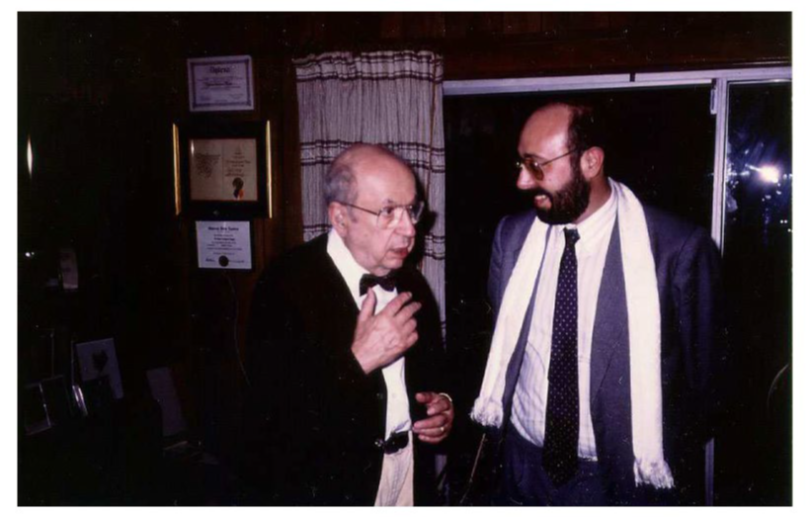
Apart from describing his magnificent work, we could say about Professor Nicholas Georgescu-Roegen by recounting the interview Antonio Valero conducted with him when Professor George Tsatsaronis and Antonio Valero visited him at his home in Nashville in 1991. Below is the interview and you can see it in the web site:
https://polired.upm.es/index.php/boletincfs/article/view/2529/2606
An interview with Nicholas Georgescu-Roegen
Antonio Valero
ENERGAIA Institute. Zaragoza University
María de Luna str, 3 50015 Zaragoza . Spain
In November 1991, Prof George Tsatsaronis, and I went to visit Mr Nicholas Georgescu-Roegen at his home in Nashville. He had been a professor at Vanderbilt University. He lived in a huge American-style villa, and the most curious thing was that the whole house was full of open books scattered across many tables, which showed how hard he worked. His wife, who was very discreet, was still alive but in poor health. I cannot imagine the grumpy Mr Nicholas without his wife’s help, as it was clear that he needed her, and they were alone in that house lost in a scattered residential area. A few years earlier (1986), I had published the Theory of Exergy Cost, and I realised that using the Second Law to conceptually approach economics yielded results that had already been described philosophically by D. Nicholas Georgescu – Roegen in the early 1971 in his book The Law of Entropy and the Economic Process. His intellectual excursion was the opposite, approaching the Second Law from Economics.
I always considered Thermodynamics to be essentially an Economic Theory of Nature and worked on it by creating a logical extension of the Second Law that included the ideas of cost and irreversibility, and with them the concepts of purpose, efficiency and causality. I did this with my collaborators in the old Carnotian style, focusing on “improving thermal engines”.
However, to my surprise, prof. Georgescu-Roegen, from the opposite field of economics, had already criticised this body of doctrine because it did not (and does not) include the concept of irreversibility and instead includes the concept of total substitutability of capital for natural resources. Jokingly, prof. Herman Daly, one of his main disciples and World Bank senior economist, refers to this as the magic trick of making a cake with only a cook and a kitchen, but without ingredients.
Georgescu-Roegen is the father of Ecological Economics, in which Thermodynamics, and with it the Second Law, plays a fundamental role. We (a few thermodynamic engineers from around the world) contributed to the creation of Thermoeconomics, which is a tool for the improvement and optimisation of energy systems. It is based on the systematic application of the Second Law using the ideas of cost and efficiency. The connection was obvious. That is why I decided to meet him in person. He was no longer up to much when I went to visit him at his home, and as we know, he died in 1994. Jacques Grinevald protested bitterly because his death went unnoticed. I was in the United States when he died, and I must say that The New York Times gave a review, which was certainly not, what he deserved, but over time, his stature will grow. He was one of the great thinkers of the 20th century.
The interview I did with him was not intended to be a journalistic interview, but simply for my own personal use. I was interested in hearing his opinion on issues that concerned me because of the development of my own theory. At least for me, it was useful. It does not cover everything we talked about, especially some of his life experiences visiting Spain and Latin America. However, it does cover his opinion on his thinking, and that was the important thing.
It has been transcribed from English so that his opinions can be better disseminated and are less manipulated. Perhaps, without meaning to, these are some of his last words. Farewell, Prof Nicholas Georgescu-Roegen.
The interview:
Nicholas Georgescu-Roegen was born in Constanza, Romania, in 1906. He tells us that despite his second name, which was Romanized, he has Greek roots.
Nicholas Georgescu-Roegen: When my father was born in the nineteenth century (1850) when he was over there, there was a special kind of arrangement. Family names at that time did not exist in Romania. People were named according to where they were from; the upper classes had the names of the places where they had their fields. The other case was almost like that of the Jews.
The Romans had a family name. The Ancient Greeks did not. It was something like that. My grandfather’s name was Athanasius, but his first name was George. And, when my father went to school he had to be listed in the register and so the teacher asked him- “What’s your name?” and he said “Stavros” “Yes, but what’s your family name?” and he said “I don’t know what that is.” -Well, what’s your father’s name, then?” ”George” -“Very well, then, you’re Georgescu!”- a romanization. Therefore, that was how it was. I should have been Nicholas Athanasius, because I am half-Greek, but it is not -and that is why.
Antonio Valero: You have always encouraged the study of the Ancient Greeks as a way of reflecting on our modern society. Do you believe that Greek thinking has determined our way of thinking, of understanding our present society?
Nicholas Georgescu-Roegen: You know, the British think (and our American colleagues) bigger and bigger. However, if the Greeks had not made us think about the cause, the “proximate cause”, the First Cause, we would still be in the same situation as the Indians or the Chinese.
Either contemplative, like the Indians, or simply registering facts without asking why. That is why they invented the compass. Aristotle talks of four types of cause. All of them explain what a thing is, what it is intended for, how it was made, why it was made. I believe the Greeks have given us this view of the world so we cannot nowadays ask one single question, which has not been asked and found in Aristotle or Plato. There is no single question.
I have just finished reading a book about the future of the human being. The problem, which preoccupies many people – physicists, chemists, astronomers – is the future of the universe.
They have always talked about this, but now the question has become “why?” Because they say that, there is more matter in the invisible universe than in the visible. Now they are trying to get knowledge of the invisible matter -i.e. matter that cannot be seen. And the way they go about that is by asking questions and trying to suggest why? why?. The Chinese language, the old Chinese does not have the word “why?” They knew only for what purpose. As I said, without the Greeks we would still be a contemplative community or society.
One of my colleagues, one day, he says (and I said to him “that’s very interesting, because that idea has something to do with what Aristotle said”: “I’ve never read Aristotle”, so I asked him why. That was the wrong word because his answer gave him away. He said, “Why should I read Aristotle? He lived twenty-five centuries before me. I live now”. I talk about it in one of my papers. I get my assistant and ask how far back the references go of a man who is publishing today, and it will be in the eighties, in 1985 or 6, say. He is in the new wave. He has not been pushed by, and he is making it. That is the idea. In addition, this is particularly true because it reflects this type of broker business philosophy.
Antonio Valero: In the Promethean Condition of Viable Technologies you propose in the end that conservation is the only solution.
Nicholas Georgescu-Roegen: Do you know why I proposed conservation? Because there’s some bad weather coming? … Some snow and I will not be able to go to the grocer’s. Because I have to live for three or four days with what I already have in the pantry. Because I should eat a little less than usual every day? No. That is not my idea.
My reason is this -In the past there have been similar crises. At one time, there was a wood crisis, such a big crisis that people tried to economise. Moreover, in England and even in Norway there are rules and restrictions attached to the cutting of trees. In addition, coal was not considered until the 16th century in Europe. The Chinese had it earlier and they used it to make oils. So they knew about it, but it was a very difficult thing to get. You scrambled over the water and there was the mine. All mines have plenty of water in them below the ground, so what do you do? Well, to get at the coal you have to take out the water, so hundreds of horses were used to drain it from the mines – the power of animals was used to get at the coal. In addition, the coal has, say, a kilogram of energy in it so it is not worth using the energy of the animals to get the water out and thereby get at the coal. Then Prometheus’ second gift arrived – the steam engine. Now, you see, at that time there was a change. We know that there have been crises in the past very similar to those we face nowadays. In addition, we know that there was a solution. A Promethean solution. Now, the Economy postponed the real catastrophe for some years. My idea is that with conservation, we gain time and in gaining time, we make it more probable for a third Prometheus to arrive. If it is to arrive. We do not know what is to come next. This way we increase our chances. If not, what is going to happen? We have to go back to where the steam engine found us. That means going back to the “wooden age”.
However, how do we get back to that? I am talking of that problem. Because you have to share your food with the animals. Moreover, there are already too many of us. If we just stopped now there would be some kind of catastrophe. People, who have nothing, would invading other places and so on. Therefore, in order to slide down slowly from the energy of the steam engine to the energy of wood and perhaps the energy of the winds and the tides and running water, which are also solar, though they are called indirect. In order to slide back to the time of Plato, of Charlemagne, of Galileo, we need a slow change that will avoid the catastrophic shake-up of humanity. In addition, this is my reason for conservation. I am not saying, oh, conservation, conservation, which people think means going without for a few days, not eating everything today. It is not that. Because that would be stupid. One of my colleagues asked me a stupid question – he said “Oh yes, conservation, conservation, but how can you be sure that humanity will even continue to exist in the next thousand years?”
Do you know Eskilos, in Antigone? When the messenger comes to tell him that Antigone has buried her brother, that is bad news, so he came and said, “I don’t want to bring bad news. Nobody likes to be the bringer of bad news”.
In addition, another thing. There are economists who do not like my theory and say “What sort of time scale are you thinking in? 500 years? 1000 years? 2000? 3000?” They want to fit me into a time scale, to be more precise than anyone possibly can be. I said, “I’m talking about the flowing future, the future that is subject to change. Change that I am not able to predict. I cannot say it will happen next year or the year after. I only know that things will go in one direction or the other and I am simply saying here that we are at this crossroads and that at the crossroads our best option is conservation. Nor is it as simple as I say in my papers. The question is not to start saying, “Oh, Georgescu’s going to start conserving”. Conservation is to be applied for just the reason I have come to work with it. I could give you a list of articles on conservation written by engineers. However, there is another way to talk about conservation and this is conservation from the point of view of entropy. You can say, “Well, there are certain mechanisms, boilers, for example, which exist in order for things to be the way they are, and with a few small modifications we can make them more useful, improve their efficiency”. Most of New York, for example, is heated by steam that comes from plants. That is an example of how you can do it. You make the system more efficient because everything remains the way it is. But this is technological conservation. Moreover, I am talking about entropic conservation, in which the conservation of materials is implicit. I formulated the fourth law, which has not been accepted. Why not? I do not know. No one has attacked it. No one has said it is OK. Some Italians have written to me and I have not had time to answer them. One paper has accused me of trying to present my Law, the Fourth Law, as something new when actually it is a known fact. That was Mr A, and then Mr B comes along and says, “No, in fact it’s wrong”. So someone says it’s true but it’s been known since the time of Tutenkhamen and another one says it’s not known at all. It is new but it is wrong. So in the end I don’t know whether what I’m saying is something new or something wrong, or what?
Antonio Valero: Do you agree that recycling is one of the solutions?
Nicholas Georgescu-Roegen: Yes, but not maybe what most people mean by recycling. You know what I said about recycling? What can you recycle? You can only recycle the “carbojunk”
That means that you can recycle the matter that is still available but not in a useful form. Broken glass, for example. You can recycle the glass, you can recycle the material, but when a glass breaks, you cannot recycle that glass. You cannot recycle some small molecules.
Therefore, you can recycle, of course, but there are some people who maintain that you can recycle completely.
Antonio Valero: And what about production?
Nicholas Georgescu-Roegen: I have written about this too. Production means time. I was in Rome, at a meeting of the Association of Italian Economists and I noticed how many people who have worked on conservation and discuss the problems of the conservation of energy, confuse the ideas of flows and resources. Many people talk about the problem of resources.
Nevertheless, what is output a function of? Labour, machinery, capital and natural resources. In Economics we can make this substitution – you can have a farm with more capital and less labour or more labour and less capital. Alternatively, more land and less capital or more capital and less land. This is the substitution. Therefore, they say, “If you reduce the resources you can increase the capital”. However, what matters is not substitution but complementarity.
Antonio Valero: What can you tell us about your professional relationships?
Nicholas Georgescu-Roegen: Listen – three or four times my old professors, my old colleagues have treated me in a most incredible way. Once I presented a paper at the International Economics Association in Rome. Only invited speakers were allowed and you had to submit your paper at least a month in advance for distribution. You personally did not present your paper. In your discussion, you had to summarise and say what you thought was good, and what was bad. My reporter was an economist from Israel, Potemkin. My paper was the first paper, the opening paper of the Congress. The previous evening we were together in the same hotel and had dinner together. Potemkin sat opposite me at table and talked about all kinds of things – paradise, hell, nice girls, bad men… this was his conversation. In addition, he had to present my paper the next day. He got up and he said, “I cannot summarise or present the content of Professor Georgescu’s paper because it is based on a fantastic mathematical error” and then he sat down.
The conference was on agriculture in the developing countries. Most of the agronomists and economists there knew nothing of mathematics. The only one there who knew mathematics was his assistant and this man, who was there to report on someone else’s paper, stood silently on the platform behind him during our exchange of views.
Before I got home, I received a letter from the secretary of the Congress in which he said: “Here is a copy of a letter from Professor Potemkin – Dear Mr X, having arrived home and read Professor Georgescu’s paper, I now realise that he was right and I was wrong. Moreover, as wrong opinions should not be put down in black and white I would like to withdraw my comments from the proceedings”. In addition, I had to approve this because otherwise the secretary could not accept it. What do you think I did? I told him to take it out. What he should have done is this, look. He would have met with me; he would have talked about the problem.
He would have told me, (before presenting my) work to two hundred people, so you would have just stood up and say, “Nicholas, I think you’re wrong”.
Antonio Valero: Do you think that humanity’s great theories and discoveries are the results of individual geniuses or of the collective mind?
Nicholas Georgescu-Roegen: People do not produce innovation and invention. The Community does. The Community is like a balloon, and when it is about to burst along, comes somebody like Newton. If Newton had not existed somebody else would have come along because the idea came to Newton’s mind as if he were some kind of interpreter. Someone asked the question – what would have happened if Newton, instead of having the mind of Newton, had had the mind of Kepler? Moreover, if Kepler had had the mind of Newton? I wrote a paper on this subject. Were they unique minds? The best argument against this idea is that there are not you cannot talk so much of “people” as of “discoveries”. Many discoveries have been made at the same time and I asked why it should be that this is so. Because some are like the answers to mathematical questions. The professor sets a mathematical problem, say – find the solution to this differential equation. Naturally, if the problem is set and it is a problem that preoccupies society, then many people will try to solve it and there would be at that time, or maybe within periods of fifty or a hundred years, the same discoveries made.
Well, I would say that, in that case, how we should see the Law of Gravity. You can look at it as a kind of power that emerges in a uniform manner in the whole of space, the further away from a body you are, the less force there is. Nowadays we see that this led Newton to what we consider his great discovery -gravity. I have given other interpretations in the past, and for other things such as optics, etc. I put it forward as an example of the kind of theory I have about cosmology. If two things are quantitatively measurable and directly connected, the relations between them are linear. There are only a few cases in which linearity works, in this way, giving a kind of qualitative residue. If you are an engineer, then you know Hookers Law, which is linear. Moreover, any lack of linearity is the residue – the qualitative residue; the phenomenon involves a quality. This is why we have so many different forms of measurability.
Antonio Valero: And what about value and cost?
Nicholas Georgescu-Roegen: You have just asked that extremely complicated question. What do you think value is? You might think in terms of something that would make people generally happy, such as democracy, good schools, good universities, and good friends. These are things, which have a value because we want them. On the other hand, the question is commodity – you work for something or you pay for it. This means that sometimes you make a trade-off of your own services for those of others. This you do in a market and this is the type of value Marx speaks of, and the Neo-classicists.
However, you will find that I am criticising the people who see energy as a value. Let us say you take some caviar and some potatoes and you calculate the energy in both of them. One piece of caviar has 1.000 calories and the potatoes you could buy for the same price has an equal number. Engels was the first to complain about this. Engels said, in 1877, that there are people who have argued by measuring the physical force of work and then established how much money this should fetch per hour. This is my criticism of Karl Marx, who only attaches one value to labour and not to any kind of unskilled labour -rudimentary labour, such as a fellow who carries heavy things around a harbour. In the end, they say, you have to be able to measure the accumulated labour. That sounds all right, but I ask – if you establish that one unit of Georgescu’s skilled labour is equal to twenty units of unskilled labour that means the two are substitutable, and my question is: how many unskilled workers would you need in order to write Das Kapital? I would say that is better than Engels is. It is a problem.
There are a couple of articles which show you just how absolute the principle is -how, if you accept the principle from the beginning, what kind of absolute you arrive at in the end.
Moreover, this is worse than in Marx’s case, where Marx was saying that labour is substitutable, whereas these people say the same thing about energy. At least Marx has a connection with people. Energy does not have this connection.
Antonio Valero: And what about purpose and efficiency?
Nicholas Georgescu-Roegen: I do not know how you can establish the connection between efficiency and purpose, because purpose is something that precedes action – a crime, for example, as the purpose of a criminal, or a dictator – it is not necessary to have a connection between the one and the other. Therefore, purpose is a general concept, which is attached to something according to a group of people who recognise the existence – and importance – of purpose. Like myself, like many others. Purpose is a general thing and it is an aspect, an element, a part of any connected action. We cannot say the moon’s orbits have a purpose, but my studying it has a purpose. Two things are connected, and the connection disappears if you eliminate the mind – purpose and error. Nature does not make errors – people make errors.
When you say 2+2=5 that seems perfect for natural science. An electron in your brain jumps and you write five instead of four. It is an error. It is because of humankind that errors exist, because of man’s activities, because their actions have a programme. My wife is European. She washes the dishes. I do not break them. She breaks them – because she is the one who washes them. Error and purpose are connected. Error is entirely due to purpose. The purpose is defeated.
Antonio Valero: Efficiency is a measure of what you want, of what your purpose is.
Nicholas Georgescu-Roegen: You want efficiency, but you also want food, you want to eat, you want to have a family, so you say that purpose is connected to all these activities. Efficiency is one aspect of our activities. Only one aspect. In addition, that is exactly what I am saying – great efficiency is desirable, but not always. Nowadays it is more efficient to go from New York to Paris by plane than by boat, but is it desirable? Would it not be better to go by boat and not enter into this kind of society? Primarily, there have been many influences on the culture of our beliefs. My philosophy is to find what is “there”. You write the sentence “What is there?” (With a question mark).My philosophy is concerned with what is causally there, do you understand? I’m not interested in what is there in the sense of “What is there?”, “What is in the house?” I am interested in the house, what is another house and what do you mean by “there”? Some people think that “there” is over there and others think that it is in another place, so I want to find out, what is “there”?
Antonio Valero: For example, causality.
Nicholas Georgescu-Roegen: I believe in causality. I am an Aristotelian. If there is no causality, there is no will. Causality means to say why, for what purpose, and then to say how. You make a statue of marble, or you make it of wood; but what kind of statue would be better made in marble, and what kind of statue would be better made in wood? Brancusi, one of the originals of abstract sculpture, said that every material has in it the type of sculpture that fits it. You take anything that is there as an artist does. You have to discover.
Antonio Valero: Here we leave Professor Georgescu in a room full of books, papers, and notes, full of his philosophy. He died a few years after this interview. He was not in good health during his last years but his mind was as bright and sharp as ever, and his temper just as grouchy.
Goodbye, Professor Georgescu-Roegen
APPENDIX
SUMMARY
Keywords: Exergy analysis, lifecycle assessment, energy transition, fleet dynamics, technology learning
curves, natural resource depletion, absolute sustainability
The distinct global transitions the world currently faces present unprecedented challenges in understanding the true thermodynamic costs of deploying newer technologies at scale (e.g., renewable energy, hydrogen, critical raw materials availability, etc.). Current lifecycle assessment (LCA) methodologies, while valuable, rely predominantly on energy-based metrics that fail to capture the quality differences between various energy forms, natural resources and downstream residues. This proposal presents a comprehensive three-code computational framework that applies exergy analysis—the thermodynamically rigorous measure of resource quality—to lifecycle assessment of general production systems (energy conversion, chemicals production, manufacturing, metallurgical, mining, technology,
recycling, etc.).
The proposed framework comprises three integrated components:
Code 1 (Exergetic LCI Aggregator): A production-ready system for aggregating life cycle inventories using exergy as the unified metric (without losing previous information about influxes and outflows, i.e., mass, composition, state, and so on), with automatic handling of multi-output processes and complete natural resource tracking.
Code 2 (Production System Exergy Cost Evaluator): An exergy-based comprehensive lifecycle productive systems analysis for a general production system, featuring a prospective dynamic evaluation of all physical costs required on its pre-operation, operation and post-operation phases. These encompass a 9-stage analysis to evaluate a system’s overall lifetime performance: ecosphere’s natural resources extraction (to technosphere) and refining, components manufacturing and transport, and infrastructure commissioning (pre-operation), lifetime operation, maintenance and residues/waste treatment (operation) (to ecosphere), and end-of-life infrastructure decommissioning (post-operation) – all both under local and global perspectives for the generated irreversibility. This code allows us to project novel fleet-lifecycle integration capability that tracks technology-specific exergy costs over time (1900-2050+) with learning curves.
Code 3 (Total Exergy Calculator): A planned extension for calculating disaggregated (local and global costs) total exergy of complex materials and products by combining chemical exergy with manufacturing cumulative exergy cost demand nder different reference states, allowing a local versus global reference state comparison for natural resources locally scarce and local residues provided to the environment.
Key Innovation: The fleet-lifecycle integration represents a first-of-its-kind capability that connects detailed system-level lifecycle assessment with either local individual or global fleet-level capacity evolution, enabling analysis of how technology improvements affect the exergy efficiency of energy transitions. This integration incorporates technology learning curves for both efficiency improvements and material intensity reductions, providing unprecedented insight into the dynamic evolution of thermodynamic costs during a production system transformation. Such a model allows comprehensive analysis of macro and micro (global and local) effects in terms of natural resources depletion
(cradle-to-grave) and waste generation (grave-to-cradle) through a novel concept called irreversibility backpack (all cumulative irreversibilities associated with the production of a product (regardless of if it is of energetic, chemical, or metallurgical origins, infrastructures, etc.) with full disclosure of all irreversibility sources throughout all resources’ supply chain and residues treatment).
Expected Outcomes: The framework will enable (1) thermodynamically rigorous comparison of production system technologies, with special attention to (2) dynamic analysis of energy transition scenarios, (3) identification of material bottlenecks and resource constraints, (4) policy-relevant decision support for technology selection, (5) advancement of LCA methodology through exergy-based approaches, and (6) the usage of exergy costs/cumulative exergy demand with associations with both natural resources depletion/scarcity creation (and their exergy replacement costs) and irreversibilities linkages with each one of Rockstrom’s planetary boundaries (and their exergy abatement costs).
Broader Impact: This work addresses critical needs in energy policy, resource management, and sustainability science by providing quantitative tools for understanding the true thermodynamic costs of the distinct global transitions we have been facing. Therefore, not only does the irreversibility backpack keep all disaggregated information regarding different environmental damage indicators but it also provides an aggregated value for them on the same physical unit basis, TWh.